Is Cash Still the King?
An 1890 Business Guide
In 1890, George McLean wrote a business guide and implied cash is king, credit is its slave. He went on to compare two states, one in which a business had inventory purchased with equal cash and credit for 6 months, and one in which only cash was used and where each has annual sales equal to total inventory. At the end of 6 months, the former would have sold only half enough to meet his/her liabilities and be in trouble at once, involving the entire ruin of his/her business. While the latter only experiences opportunity cost, which is not the same as tangible cash lost due to claims by a creditor.
He makes the point that for a businessman to purchase a stock of goods, agreeing to pay at a specified time, when he has no assurance that he will be able to pay it when mature, is a fool’s errand. So the “Cash is King” mantra by the neologist George McLean was primarily meant for retail businesses in its era. What of today? What is cash the king of?
Leverage: Yesterday and Today
Now for sure, the credit markets were not nearly as sophisticated two centuries ago as they are today — but also for sure, less experience is required to do a profitable business where all its transactions are conducted strictly on a cash basis. For leverage, borrowing and credit require more skill in the art of accounting to manage today than yesteryear. The stories about over-leveraging are ubiquitous in business and investing lore. Most recently, Leopold Aschenbrenner — the previous AI researcher who wrote a 160+ page AI Manifesto and launched a hedge fund exceeding 400% leverage — went bust and suffered a $35+ billion loss in a few days.
Though leverage magnifies gains, it’s a greater asymmetric risk because losses are magnified worse due to interest on the loans and the “put up or shut up” on the margin-call, lending side of things demanding more cash one may not have. Mr. McLean writes:
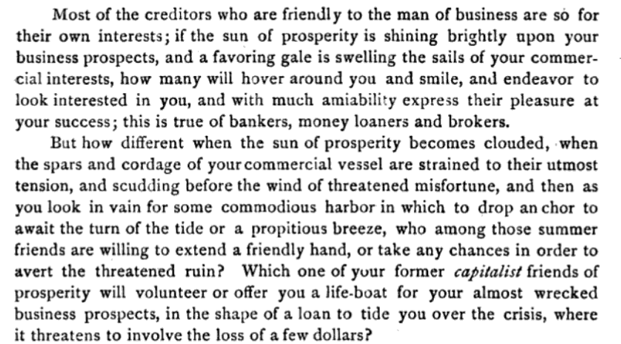
For this reason, and in the business of selling animate objects (retail vs. software or services), the sanity of cash business written in 1890 makes sense. The cost of credit, when summed, is more than the nominal cost of the money — it also can involve large emotional and reputational endangerment, and of course real dollar losses.
Cash as Capital Preservation
That said, for the prudent investor or business that largely lives within their budget and means, a necessary amount of cash and leverage is required. Cash is part of a capital preservation strategy, serves to reduce volatility, is a buffer against losses, offers an assist to new opportunities, and can even earn a little income from interest-bearing accounts. It is a drag on a portfolio during bull markets, however, and has some opportunity cost associated with its protections.
What then to do with the cash if it’s substantial? Suppose you’re awaiting an opportunity to surface and have a good-sized “chunk” sitting there. What can you do to safely protect it but earn a buck on it too?
Modern Options for Idle Cash
Fortunately, with the sophistication of the credit and bond markets these days, there are many options:
How BlueFire Manages Cash
At BlueFire, we hold all investors’ assets in a pooled investment vehicle where we remain mostly fully invested. Moreover, we can and do leverage up to roughly ~10% of the total account value when we believe an opportunity exists to magnify returns while managing the downside and volatility. Additionally, we can hold as much as ~10% cash when we believe market risks are high.
In between, for a new investor joining the Fund — say, at the beginning of the month — their funds would not be invested until the next rebalance date, which could be more than a month away. Likewise, for redemptions, 30 days’ notice is required and then paid out at the end of the following month. Therefore, cash can accumulate for these reasons within the Fund.

Investments involve risk and, unless otherwise stated, are not guaranteed. Information provided is for educational purposes only. Be sure to first consult with a qualified financial adviser and/or tax professional before implementing any strategy discussed herein. Past performance is not indicative of future performance.