What’s in a Drawdown?
Periodically, the catchphrase “drawdown” is dropped in the media. It’s defined as the peak-to-trough decline of an investment or portfolio, usually measured in percentage terms over some specified period. It outlines what is the loss and the magnitude of that loss in the holding period.
Drawdowns serve as a critical indicator of risk and volatility. Proper diversification and risk allocation are processes which help alleviate investment risk and achieve stable investments over time because a −50% drawdown requires a 100% gain to get back to even, which is an extremely hard achievement and can take lots of time to accomplish. Two investment strategies may have very similar returns but the one with the lower maximum drawdown usually is the lower risk strategy and easier to hold during market turmoil.
In comparing stocks, funds, indexes or ETFs, one would expect the lower the volatility, the lower the drawdown when measured over the same time period. The chart below is borrowed from some data that Charles Schwab publishes periodically, obtained from their data sources. Included however is the same data over the same time period (year-to-date) for the BlueFire Large Cap Fund, L.P. for comparison.
We include approximate values of the year-to-date (YTD) returns, the maximum drawdown, the absolute ratio of returns to drawdowns and the average member of the index or portfolio’s maximum drawdown.
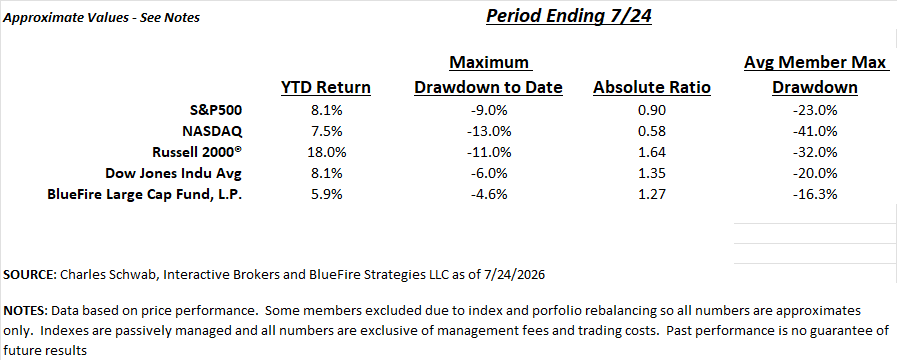
While the BlueFire portfolio’s return to date isn’t as strong as the indexes (the small cap Russell index especially is currently exhibiting above average performance), the drawdown is the least in the chart and the ratio is the highest which goes to show the design of the BlueFire portfolio is doing its job. The BlueFire strategy is a lower risk strategy by design and its member stocks are of higher quality and lower valuation on average than the indexes which is again a chosen design.
If your investment goals include preservation of capital, lower risk and avoidance of large drawdowns overall, the BlueFire portfolio could be a good choice for you.
Please consult your financial advisor before committing capital as there are no guarantees of future performance and risks include loss of capital when investing in the equity markets or BlueFire funds.

Investments involve risk and, unless otherwise stated, are not guaranteed. Information provided is for educational purposes only. Be sure to first consult with a qualified financial adviser and/or tax professional before implementing any strategy discussed herein. Past performance is not indicative of future performance.