AI: Nirvana or Armageddon
If a single grain of sand makes no sound upon falling, but a million grains of sand make a sound upon falling, a million “nothings” becomes a “something.”
Paradoxically, however, if you start with just over a million grains — say, 2 to the 30th power of sand crystals (silicon dioxide) — and every day you let half of it fall, and day by day, half of the remainder fall, then in a mere 31 days you’ll have exhausted all the sand. The same cannot be said of a solid piece of quartz made from a million grains of sand whereby each day you break off half of the material and drop it to the ground. Even after innumerable days, not all of the quartz will ever be exhausted from your hand, because you’ll always have the other half left.
The difference is due to discrete numbers of something, versus a continuous variable of something. An integer cannot be halved and stay an integer, while something continuous can always be halved — halving “Pi” for example, 3.14159265359…, will occur forever. Halving 1,073,751,824 consecutively will be done after 31 times.
Is AI Actually Intelligent?
Puzzles keep us human because they’re fun. AI is not really intelligence, therefore, because it doesn’t enjoy puzzles. It doesn’t even know what a puzzle is. AI is basically a large counting machine. Given a question, it simply ranks what is the highest probability of what the next word to follow the question should be, and so on. And to do this, it needs basically all spoken words in the sequence in which we humans have spoken them in its database to run comparative analyses. It’s computation for sure, and needs lots and lots of silicon (computer chips) to do this calculation using a type of neural net.
All “Large Language Models” (i.e. AI) are neural networks, but not all neural networks are LLMs. Nevertheless, neural networks were first mentioned in scientific literature in 1943. By 1951 the first application appeared in a computer, and in 1958 the first trainable neural net was run and used for pattern recognition. The math has been around for a long time, but only modern computing is large and fast enough to do much useful with it. The history and literature of neural nets and AI is deep and wide, and I won’t pretend I’m an expert — but I do know about algorithms, and AI in its full application today is pretty astounding, that I’ll say.
Nirvana? The Socialism Question
But will it kill us all? Or will it make socialism a reality because it’ll have expert knowledge to allow full automation of production of goods and services, through robots and machines so ubiquitous nobody will have to work for anything — i.e. “nirvana”? But we make the best use of spontaneous interaction between buyer and seller and between demand of goods and their supply. This historically occurred due to each of us pursuing our own goals in a free society and market, so no one “being” has all knowledge to shape the economy. Would AI constitute the one “being” and so fail to harness the wisdom of crowds that creates our free and innovative economy — making socialism the crime against humanity it always has been, reducing us all to a shared level of poverty?
The Fed Chair’s Questions
Our new Federal Reserve Chair Kevin Warsh recently asked:
- Will the application of AI cause a significant, sustained rise in productivity across the economy? And if so, when?
- Will token usage be complementary or competitive to labor?
- Will the next generation of AI models demand even greater capital intensity, or will the models themselves help devise a capital-light solution?
- It’s not obvious where the returns on capital will land or on what timescale. Early on, how much of the surplus goes to owners of scarce assets — AI labs, chipmakers, energy producers, and cloud providers?
- Over time, how much of that value accrues to businesses and consumers?
- What are the broad implications for workers and for the employment side of the Fed’s two-fold mandate?
- Likewise, we don’t yet know the equilibrium price of the tokens. Might there be a heterogeneity of tokens, such that growing sums will be paid for access to the best models at the frontier?
- Will token prices for older models fall to the level of their marginal cost?
I ask, when will AI be able to self-replicate?
The AI Buildout in Historical Context
The chart below was created by BlueFire, examining several sources and contriving a range of estimates. One can see the historical percentages of capital expenditures to GDP at each time from the specific industry buildout, compared with those of the AI buildout currently under construction, noted by the rightmost blue bars.
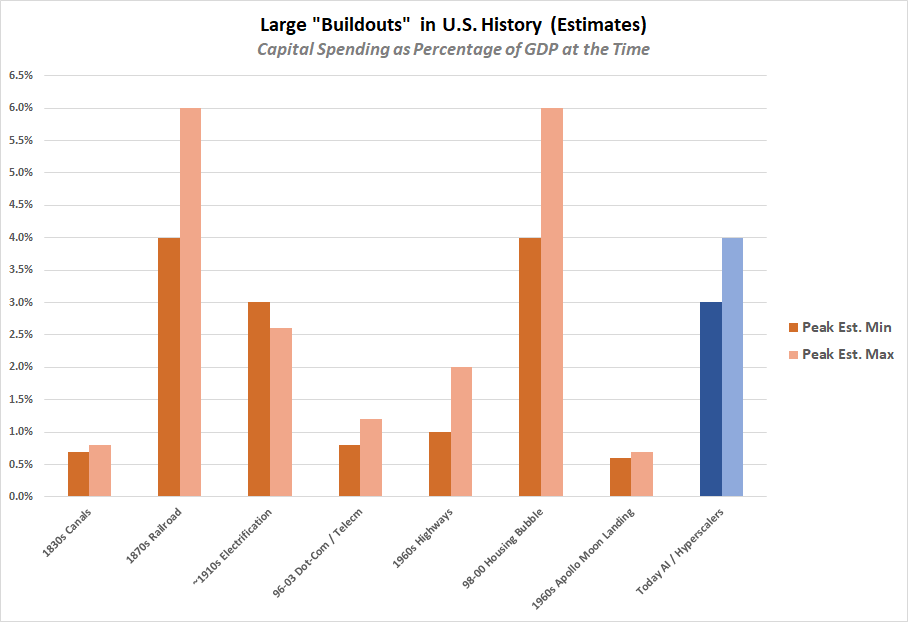
The current AI expenditures are less than the housing and railroad buildouts, but greater than the others — comparable to the electrification of the U.S. which occurred in the 1920s through the 1930s. These are the levels of cap-ex, however. The rate of change of the levels is suspected to be more important for a stable economy. Imagine the “bust” of any of these in the chart. If the expenditures slowly back off over a longer time, the economy can swallow the change without ruining the stock market and raising unemployment. Likewise, if the rate of increase is fast, the economy would have a hard time adjusting, and it could create a stock market bubble. However, speed is relative to the era of the spending, as news and the ability to adjust prices in the market today are very different than the railroad era, for example. That the AI buildout is fast is noted everywhere, but is it fast enough, relative to the ability of investing participants to adjust? One would believe you cannot build a data center in a day, so the regular rate of construction puts a lid on the speed of the expenditures.
Off the Charts Demand
That all said, Nvidia’s supply chains are running flat out. If Jensen Huang goes to lunch with a CEO of a supplier, the supplier’s stock doubles the next week. AI agents run 24 hours a day and use 20 times the compute power than a human asking AI a question. Demand is off the charts, through the roof, sky-high, off scale, phenomenal and unprecedented, and the business is severely supply constrained.
Agentic AI agents can run autonomously, plan, make decisions and take multi-step actions to achieve an owner/user’s goals with very little oversight. Then, they grade themselves and learn so they can do it better the next time. They reflect and adapt, write computer code and automagically readjust workflow as needed. But they have no feelings, cannot appreciate humor, and… all the ingredients for increasing unintelligent demand are there.
Will it level off? Well, has computing demand ever leveled off? Computers find themselves continually in demand since, well, the invention of them. Computing time on a computer has also always been in demand, and still is. To the extent AI assistants/agents will become every person on the planet’s “pet” over the next 10 years, I foresee the business of creating AI infrastructure will be hardy and forthcoming over the next decade. I don’t believe AI will go bust soon — though there will be winning and losing companies, as there always has been. Lastly, the ROI, return on investment, is indeed beginning to happen. As people figure out how to use AI and get creative about its applications, the ROI will shorten and shorten.
Armageddon?
This would require the usefulness of humans to vanish. If robots armed with AI are able to self-replicate as well as operate independently, design objectives, reason and plan, use tools (other machines), reflect, adapt, code and automate other tasks — what are we humans needed for? The “AI Machine” would have to become us, basically. That would mean they’d have to come up with a purpose for being. How could that occur without self-awareness, without becoming sentient? Without a soul that can appreciate art, feel, or experience subjective sensations? There’s no room for “art” in an inanimate object.
I don’t fear Armageddon or a takeover of living beings. I do fear the use of AI and all its manifestations, however, in war or for malevolent endeavors by “KAOS,” “THRUSH,” or less humorously, a North Korea or Iran.
A Cosmic Digression: AI and the Fermi Paradox
By the bye, we’ll probably never be visited by aliens from another planet. But, being visited by robots run by AI algorithms from other planets is probable, if we’re not already. Imagine life on some distant planet that creates a robot that can self-replicate and do all I’ve said before about being agentic. Then, it only needs to reach another planet that need not be life-sustaining, opening up many more such opportunities than only finding a life-sustaining planet. On that planet, say it takes ~100 years to build mining and manufacturing facilities to make more of itself and build rockets, then shoot them off in myriad directions to other planets where replication happens a thousand times, and rockets each off to another planet over and again and again.
In this way, computation (there’s the need for computing again) shows this process could reach every star system in the Milky Way galaxy in a few hundred million years. Given our galaxy is ~13.6 billion years old, what’s a few hundred million years? This would explain the UFOs that change direction and turn 90 degrees while flying at Mach 5 our government now acknowledges are here. The “g” forces for such a turn would kill “life,” but it won’t hurt a machine — an AI self-replicating robot flying such a spaceship. Perhaps these AI agentic self-replicators are already here?
The Verdict: Neither Nirvana Nor Armageddon
I believe AI, like other technologies, will lead to transforming the way we live for the better — just like fire, the wheel, the lightbulb, air conditioning, the silicon wafer, computing and the internet. For better and worse, but mostly for the better. It won’t be nirvana, but it won’t be Armageddon either — but maybe “nirmageddon.” It will increase our lifespans and allow for more time off from things we don’t want to do, and more leisure time.
But, not yet. A short generation away is its timetable. In the meantime, we still haven’t created a machine that you can dump a handful of pistachios into on your countertop and have it de-shell them for you quickly. I don’t really mean “mean-time” either — I mean the “here and now,” not average time.

Investments involve risk and, unless otherwise stated, are not guaranteed. Information provided is for educational purposes only. Be sure to first consult with a qualified financial adviser and/or tax professional before implementing any strategy discussed herein. Past performance is not indicative of future performance.